
Your staff are getting Copilot. Most AI training won’t change what they do with it.
Microsoft 365 Copilot is rolling out across the NHS. The usual session shows people which buttons to press, and a week later nothing has changed. The tool sits unused, or gets used outside your IG boundary.
I build the opposite. Over twenty years training NHS and regulated-sector staff, including recent clinical-systems work for an NHS foundation trust. Two-hour working sessions, remote, mapped to your own IG policy, every example on dummy data. Staff leave with something they will do differently tomorrow morning.
I don’t sell software guides. I sell real-world usage.
It isn’t AI training. It’s AI adoption.

Your staff are already using AI. The question is where.
The safe option has to be the easy option. That is what stops shadow AI, not another policy reminder.
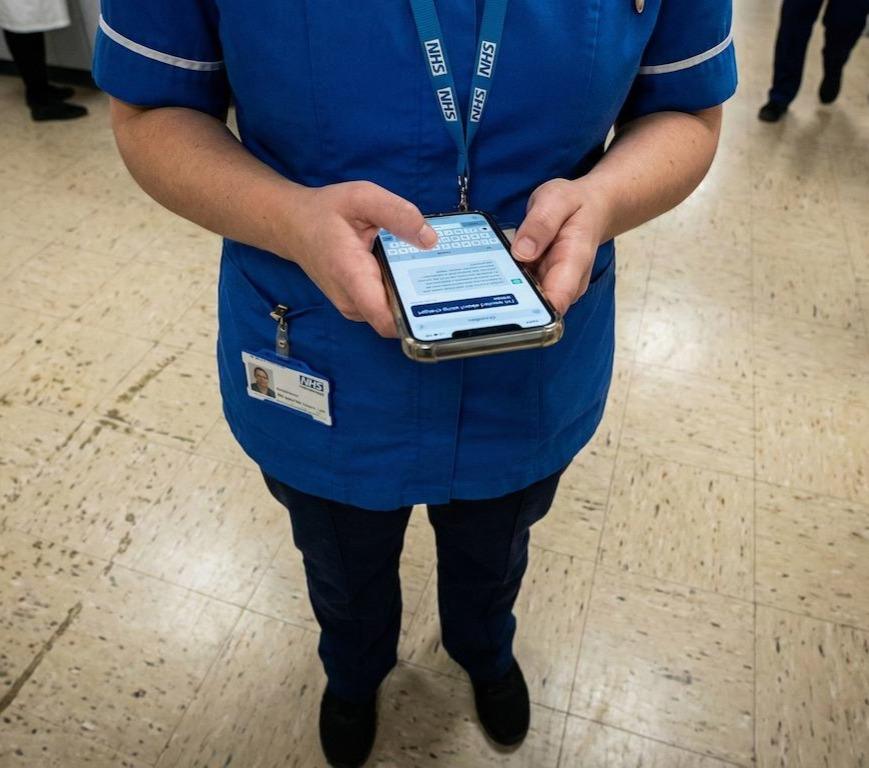
Two hours. Remote. A working session, not a webinar.
Staff join over Teams from their own desks. No prior experience assumed. The pace is set for a mixed room, from staff who have never opened Copilot to those already using it daily. Nobody sits and listens for two hours.
Safe by design, not by disclaimer.
Three rules run through every session, taught as working habits, not read as policy.
- RED DATA Patient identifiable data: NHS numbers, names, DOBs. Never in the prompt.
- AMBER DATA Anonymised notes, rotas, internal policies. Safe within your tenant, with a check.
- GREEN DATA Public information, leaflets, general admin. Safe everywhere.
Pilot. Review. Your call.
This is a staged model. The pilot produces evidence, and the evidence drives every decision after it. Nothing is committed beyond the stage you are in.
| Stage | What happens | What it produces |
|---|---|---|
| 1Pilot | The standard course runs with your first cohorts: 2-hour remote working sessions, up to 15 per session, with pre and post-course confidence and workflow assessments. | Trained staff, plus data on confidence and usage |
| 2Review | I bring you the findings: what landed, what didn't, where resistance sits. | The evidence you need for the rollout decision |
| 3Your call | Continue the standard course across further cohorts at the same session rate, or customise: extra modules, content reworked to your workflows, Copilot agents with your policies and forms embedded, an advanced course built to your specification. | A rollout shaped by your evidence, at your pace |
Any NHS organisation putting Copilot in front of staff.
- Acute, community, mental health
- Corporate services
- Admin teams
- Clinical support
- Programme teams
- Communications
- Business support
- Practice managers
- Reception and care navigators
- Clinical staff
- CSUs and federations
- Social care providers
- Organisations working to NHS IG standards
Open to clinical and non-clinical staff. Mixed rooms work. The format is built for them.
Delivery details
| Delivery | Multi-modal. Remote facilitation via MS Teams, on-site face-to-face working sessions, and custom e-learning module development for internal hosting. Teams delivery operates on your tenant to ensure full compliance and functionality. |
| Session length | 2 hours |
| Group size | Up to 15 per session |
| Scheduling | Flexible, including out-of-hours for clinical availability, at no extra cost |
| Licensing | Works on all versions of Copilot. Content adjusts if paid M365 Copilot licences are in place. |
| Booking | Named places booked in advance. A ready-to-send joining email is provided, so circulating it costs your team nothing. |
You get me. Every session.
I’m Chris Whitaker. I deliver every session myself. The person who scopes your training is the person in the room, and the same person every time. No associate sent in my place, no junior, no different face each cohort.
I’ve worked in NHS and social care, and I hold valid sector qualifications. I don’t need your acronyms explained, and I know the difference between a patient and a client. I know what a winter crisis actually feels like on a ward. That matters when the room is full of change-fatigued staff who have watched every initiative come and go.
Most rooms need the standard session and nothing more. Now and then a cohort is genuinely tough, the kind that has defeated training before. If yours is one of those, you are not stuck with the standard playbook. There is a specialist option. Ask, and I will talk you through it.
My work is still in use across several NHS trusts, with references happy to validate it. My most recent engagement was clinical-systems training for an NHS foundation trust, whose clinical lead said it was “much more how I want our training done.”
Professional indemnity and public liability insurance are in place, and full procurement documentation is ready to send. My complete G-Cloud 15 application went in before the January 2026 deadline and is now with the assessors. A framework decision is expected later in 2026, though government timing is never guaranteed.
Why this approach.
Click to expand.
The numbers
NHS England’s rollout covers roughly 505,000 staff. In the trials, practice managers saved 43 minutes a day. 57% of employees admit to hiding their AI use from employers (KPMG, 2025), outside any governance boundary.
The opportunity and the risk are running in parallel. The training addresses both.
Why mandatory training fails
Awareness and adoption are different mechanisms. Decades of transfer-of-training research show course attendance alone does not change workplace behaviour.
Psychological reactance research shows imposed tools generate resistance and workarounds even when the tool is objectively useful: telling staff they must use something makes them less likely to use it. This course is built on choice and relevance, not compliance pressure.
The time argument
The Topol Review called for a digitally ready workforce to release time for care. Eric Topol argued that AI's greatest contribution to healthcare isn't replacing clinicians, but giving them the gift of time with patients.
Copilot is taught here as a time-creation tool, not a decision-making tool, automating non-clinical drudgery, never crossing clinical lines.
Clear numbers. No surprises.
| Item | Cost |
|---|---|
| Standard course, per 2-hour session (up to 15 delegates) | £650 |
| Pilot: 3 sessions, including pre and post confidence assessments and a written findings summary | £1,950 |
| Customisation: specific workflow mapping, custom e-learning modules for your LMS, local Copilot agent builds, and internal IG policy integration | Quoted in hours, agreed in writing before work starts |
Prices exclude VAT. Further sessions continue at the session rate. Customisation work only starts once a written estimate is agreed. The invoice never contains a number you haven't already seen.
Book a 30-minute call.
I’ll walk you through what’s covered, how the data rules map to your IG policy, and how the pilot works. If it isn’t a fit, you’ll know inside half an hour.
Not for your team, but you know one that needs it? Forward this on, or send me a name and I’ll take it from there.
Sources & further reading
- NHS England: 500,000 NHS staff to get new artificial intelligence tools to help free up more time for patients (June 2026)
- GOV.UK: Major NHS AI trial delivers unprecedented time and cost savings
- Microsoft: NHS England accelerates AI adoption with Microsoft 365 Copilot (June 2026)
- The Topol Review: Preparing the Healthcare Workforce to Deliver the Digital Future (NHS Health Education England)
- KPMG: Trust, Attitudes, and Use of Artificial Intelligence: A Global Study 2025. 57% of employees surveyed admitted hiding their AI use from managers and colleagues (n=48,000 across 47 countries).
- Microsoft & LinkedIn: 2024 Work Trend Index. 78% of AI users are bringing their own tools to work (BYOAI); 52% are reluctant to admit using AI on their most important tasks (n=31,000 across 31 markets).